

 Español
 Italiano
 Polski
 Norsk
 Danish
 Українська
 العربية


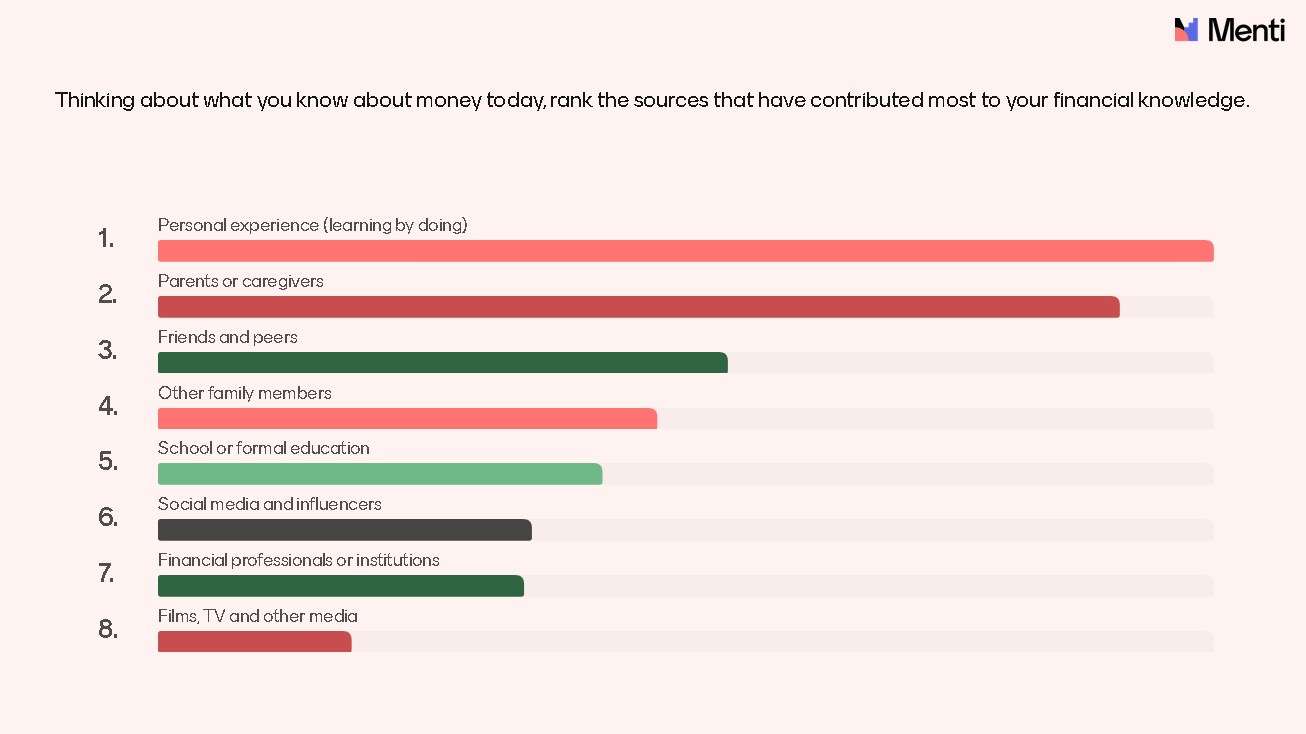
At the final PROFIT conference on 27 October 2026, we asked our 42 participants a simple question: how did you learn about money?
The most common answer was personal experience. Parents and caregivers came second, and schools barely featured. Most people in the room started learning between the ages of 8 and 14, and most did it the hard way. Many grew up with one idea about money, a split between money to be saved and money to be spent, and had to work out everything else alone.
The room was full of educators, researchers, youth workers and finance professionals. If they learned by trial and error, it is easy to imagine what the young people they work with are facing.
We opened the conference with the following question: what do we want to normalise for young people when it comes to money? Talking openly about it? Asking for help before a small problem becomes a big one? Making mistakes and learning from them?
A gap young people already see
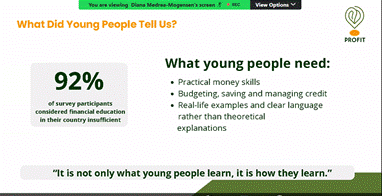
The research behind PROFIT was presented. 92% of our survey participants said financial education in their country is insufficient. Young people told us they want practical skills such as budgeting, saving and managing credit, explained in plain language with real examples.
The central point was that how young people learn about money matters as much as what they learn. The PROFIT eBook was also introduced, which turns the research into practical guidance, as well as the Financial Dictionary, which explains key money terms in plain language.
The cost of learning the hard way
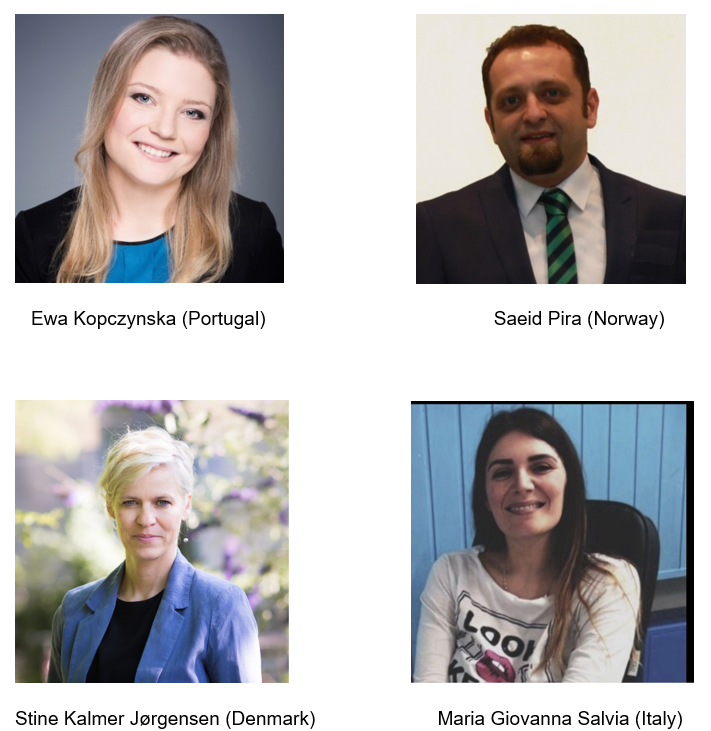
Learning from mistakes works, but money mistakes carry consequences that last. Ewa Kopczynska (E&D Consulting, Portugal), who moderated the panel, described how housing insecurity and low income leave many people discouraged, and how shame over past financial mistakes stops some from seeking help at all.
That shame looks different from country to country. Stine Kalmer Jørgensen (CEO, Dreamplan, Denmark) described a Danish reluctance to talk openly about success. Saeid Pira (PhD Research Fellow, Molde University College, Norway) explained that in Norway and Sweden, money is tied to status, so admitting difficulty feels like admitting failure. Maria Giovanna Salvia (Reception and Integration System, Municipality of Tito, Italy) said money is less taboo for the migrants she works with: everything in their new country is new, so asking feels natural. The taboo weighs more on Italians, who are expected to know already but have nowhere to go with their questions, so they stay alone with them and the shame attached.
Silence about money passes from one generation to the next. Stine added that digital payments have made this harder. Children once watched coins and notes change hands. Today money moves invisibly on a screen, and parents have less to point to when they teach.
Who should break the silence
The panel agreed that no single actor can do this alone. Saeid argued that universities can teach practical knowledge on budgeting, living costs, part time work and taxes without acting as financial advisors. Maria called for parents, associations, institutions and educators to work together, with educators as the bridge between families and young people. Stine placed part of the responsibility on the financial sector: products should be simple and safe enough that no young person falls into debt for lack of specialist knowledge.
From the audience, Karyna, an educator from Ukraine now living in Poland, pointed to the role of public policy. Where financial education has no dedicated place in schools, families and individual teachers fill the gap as best they can.
A safe place to get it wrong
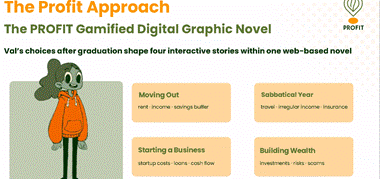
PROFIT was designed to address this gap. It is a gamified digital graphic novel that follows Val, who has just finished her studies and must decide what comes next: moving out, taking a sabbatical year, starting a business or trying to build wealth fast. Players make her choices about rent, income, loans, investments and risk, and each decision shapes the story. A bad decision in the game costs nothing, and it can be used as a good conversation starter.
We piloted the novel with 120 young people in 12 sessions across five countries. Realistic scenarios kept players engaged, and their choices made them reflect on consequences. One participant put it this way: “It didn’t feel like a lesson. It felt like a story I was part of.” The pilots also showed where work remains, especially on mobile accessibility and in-game feedback.
The shared conclusion of the day was simple. Honesty helps. People learn more when others share their experiences, mistakes and successes alike, than when everyone keeps quiet.
PROFIT continues
The novel, the Financial Dictionary and the research remain freely available. Use them with the young people you work with, and talk about money with them more openly than most of us were taught.
Thank you to everyone who took part.
Project website: profit.erasmus.site
All resources, including the eBook and Financial Dictionary: profit.erasmus.site/#results
Play the novel: profit.erasmus.site/novel